10 years of working on Afghanistan and almost 8 years of
living in Kabul! ‘How was it?’ It’s a question I am often asked, sometimes with
awe but more often with apprehension. It’s a question that brings myriad thoughts
and emotions to my mind, as well as a glowing sense of pride and satisfaction. I
cannot point to just one aspect that made this journey wonderful, so where do I
begin?
Afghanistan was an enigma, a distant place somewhere beyond
the mountains, and knowledge of it was restricted to what little I had read in
school books and newspaper articles. I remember reading the Kabuliwala (an original Bengali short
story by the Nobel Prize recipient Rabindranath Tagore), and watching on
television the unfortunate bombing of the Buddha statue in Bamyan. When the
opportunity of an assignment in Kabul came knocking, the desire to do something
different sparked in me. It was a line of profession for which I had neither aspired
nor trained for. I was content living and working in my hometown Chennai. But
the chance to experience a new culture, to learn new skills, and visit home
every 2 months was a lure. So, I found myself sitting in an interview where I
was asked questions about the public sector. My answers were mostly in the
negative (using the Indian ‘nod’ as many of my colleagues say), but I impressed
upon my interviewers that I would learn. Passion is not something I lacked, and
maybe it showed. Thus, I made the move from a seemingly normal city to a
fragile state in July 2006. In all those years in Chennai when I used to
frequent the restaurant ‘Kabul’, I had the remotest idea that one day I will go
to live in the REAL Kabul!

I owe my beautiful, and almost poetic existence
in Kabul to many - my colleagues, friends, housemates, clients, and to the
drivers, facilities and security staff in the office.  This is not a token
acknowledgement, those who have lived in Kabul know too well it is that
spectrum of support system absolutely needed to survive there. The settling in process
took no time at all as I had help to carry out the tiniest of tasks, such as even
changing a light bulb. I empathized with those who did these tasks as there was
no expectation in return except for a genuine tashakor (`thank you` in Dari, the local language). Small change was
purely voluntary if one could spare it. Talking of thank you, one of the
distinct things about Afghanistan is its way of greeting. It goes on for a full
two minutes, exaggerations aside, starting off with salam (greetings), chitor
asti? (how are you?), and sehat khoob
as? (is your health ok?), before continuing in a long but endearing flurry
of niceties that end up completely losing you. In all those years, I never
figured out entirely what they said. But I was polite, I smiled and returned
the greetings. Another linguistic and cultural peculiarity that stood out was
the liberal usage of the term ‘jaan’
(meaning `dear`). The first time a colleague addressed me as ‘Asha jaan’, I
cringed. For an Indian, it has a different connotation, being a term of
affection reserved only for a romantic partner. But I came to appreciate that Afghans
use the term for everything that is cherished. It became part of my vocabulary
too.

I arrived in Kabul at a time when the security situation was, relatively speaking, not bad; I drove around in a soft skin vehicle, shopped at the local grocery store, went to the Butcher street for fresh vegetables, enjoyed Friday
dosa
brunch at Delhi Durbar, had a long list of go-to restaurants and frequently walked
the length of Chikan Street shop-hopping for shawls, rugs and trinkets. Le
Bistro sold beautiful paintings, but I found them atrociously expensive. The small shop across the restaurant had a few, painted by the owner. They were not great, but good enough for a souvenir. I took a taxi once, just once. Interestingly almost every taxi in the city was a Toyota Camry; it influenced my decision not to go for it when I did buy a car after leaving Kabul. The Camry had lost its charm. The shar-e-naw market, a must visit, was deceptive in its appearance. It surprised me with the merchandise it offered especially the shoes that were worthy of a ramp walk! I replenished my stock of dry fruits from a regular store, and while the shopkeeper weighed and packed them, I wouldn’t stop popping the long green
kishmish into my mouth. I also did the obvious – read and watched ‘The Kite Runner’; and became a proud owner of the book ‘Afghanistan over a Cup of Tea’ by
Nancy Dupree, and hand woven kilims, carpets and donkey sacks! Carpet buying was an enlightening experience, I had not realized I could sound knowledgeable by discussing the knots in a carpet.

I enjoyed short walks up the small hill
close to my home in Wazir Akbar Khan neighborhood. I frequented the UN guest house, a favorite hangout for its pool and squash court, and more so for its Wednesday salsa nights. A one-off day trip to Qargha lake combined a tour of Babur gardens and a sneak peek of the Kabul golf course. I visited a
gurudwara too in faraway Karte Parwan area. I wished to witness the
legendary
Buzkashi (the Afghan
national sport, like polo – but using a goat or calf carcass instead of a
ball!), but never got a chance. I
recommend with caution the Mandawi market – the largest wholesale market in
town that combines cacophony and chaos effortlessly. Disorder is the order of
the day in this place and it takes talent to maneuver around. There is nothing
that cannot be found here – spices, copper vessels, clothing, and the
ubiquitous Afghan elderly gentleman in his characteristic turban and beard.
On the innumerable trips I made across the city, I watched with curiosity the street side shops by the Kabul river and the flock of  pigeons by Shah-du-Shamshira mosque, but failed miserably in my attempts to get a good picture from the moving car; it was a no-go zone on foot. Even in the days of flexible movement, attending weddings locally was not allowed. When a colleague got engaged, special permission was granted to attend the celebrations. I was thrilled to be part of the ceremony, sitting with the women folk on one side of the venue, while the men sat on the other side. Interestingly, each side had its own dances. Contrary to popular notion, I saw that Afghans loved their dance and music, if Attan – the national dance of Afghanistan accompanied by the drum - is one example to go by.

Many middle aged Kabulians remembered my city as Madras, the
old name for Chennai. More than once I was asked if I had met the famous
Amitabh Bachchan (popular Indian actor) or some random actor from the 80s, and
I speculated if Bollywood was frozen in the 80s and 90s in their minds. No
wonder Ariana cinema mostly showed movies from this time, many unheard of. That
many Bollywood actors (particularly the Khans) could trace their ancestry to
Afghanistan was a revelation to me. The dynamic younger generation was eager to
demonstrate its English and Urdu skills, thanks to which I never picked up Dari
(one of the two official languages and a variety of Persian) beyond the basics.
I must speak of the country’s hospitality; no Afghanistan story is complete
without it. Always overwhelmed by the quantity of food served, I wondered if my
Afghan hosts expected me to eat all of it.
But amid all the kebabs and meat offerings, there was a generous
vegetarian spread that I came to relish. The Kabuli pulav, eggplant dish and the bolani
remain favorites. Seasonal fruits are something to die for; I have seen boxes and
boxes of fruits checked in on flights out of Kabul. Somehow the honeydew melon never tastes the same anywhere else. The nation swears allegiance to green tea that is equaled only in its royal accompaniment of dry fruits. I was convinced that green tea is a magic potion, how else to explain for very few overweight people in a largely meat eating population! Too bad I never developed a taste for it. The food culture clarified why Afghans did not understand the concept of vegetarianism, and I convinced no one with my explanation.
In 2006, I remember Kabul was
pockmarked with some badly bombed buildings, but despite its  dilapidated
condition the Darul Aman palace’s erstwhile grandeur was apparent. Outside of
Kabul, the landscape is a magical creation of valleys, streams and rugged
mountains that left me in awe. It will be a vain attempt to try to describe the
breathtaking beauty. I got thrice lucky with Bamyan, traveling to where the
imposing Buddha statue once stood and the brilliant blue waters of the tranquil
Band-e-Amir lake glitter. A stunning aerial view from behind the ‘statue’ is
totally worth the trek up the
 mountain. I also trekked up a cliff to see the ruins of Shahr-e-Zohak and its mud-brick towers. I had my first experience of
flying in a 16-seater aircraft, landing on a narrow strip of land that was the
runway. Staying at the basic ‘Roof of Bamiyan’ hotel on one trip, an early
morning breakfast on the roof with the valley and the mountains in view, and the
chill April winds caressing the skin was nothing less than a 5-star experience.
Coming back from my last trip to Bamyan,
 I packed and went to the makeshift airport,
sat there fidgeting for a few hours, only to be told to return as the flight
from Kabul didn’t make its journey due to bad weather – this happened for 3
days in a row! Road travel was not an option, and I could have been stranded
there for days. By the 3rd day, I was on the verge of literally
crawling up the walls of my hotel room, if it were not for the long evening
walks in the valley that kept me sane.

I
traveled to Mazar-e-Sharif twice. A road trip in 2007 took me through the
Salang tunnel, and I  stopped by in Tajqorghan to buy enormous pomegranates –
they were a beautiful crimson red. While
on a field visit, I excitedly walked the road/rail bridge that connects
Uzbekistan across the Amu Darya river, and visited Mazar’s famous Blue Mosque.
I also made short trips to the provinces of Parwan, Kapisa and Panjshir, but
Herat and Badakshan remained elusive. It was a different group of colleagues on
every trip and we always had a great time bonding. Driving through the rustic countryside
always promised random sights of the kuchis
(nomads), people on donkeys and occasionally, discarded machine tanks. Living
and traveling in Afghanistan demystified the place for me.

Ten years is a long time to summarize
in words; there are still many details that merit mention. The warm Afghan nan straight out of the tandoor from the street corner bread
shops - they were priced dirt cheap! On a winter evening, they would quickly
vanish in the car even before I got home. Congregating at the Indian restaurant
Anar for cricket matches. Early morning city tour sitting in a bullet proof SUV,
although a rarity. Boys playing cricket or football, or flying kites in the
city. Getting used to the walkie-talkie radio and it’s call sign. Carrying my shawl
everywhere, even in warm-warmer-hot Chennai, having got so used to it. The view
of the distant snow peaks from a sunny Kabul and the colorful blooming roses. Gawking
wide-eyed at the fruits growing in the office garden, all at hand’s reach but
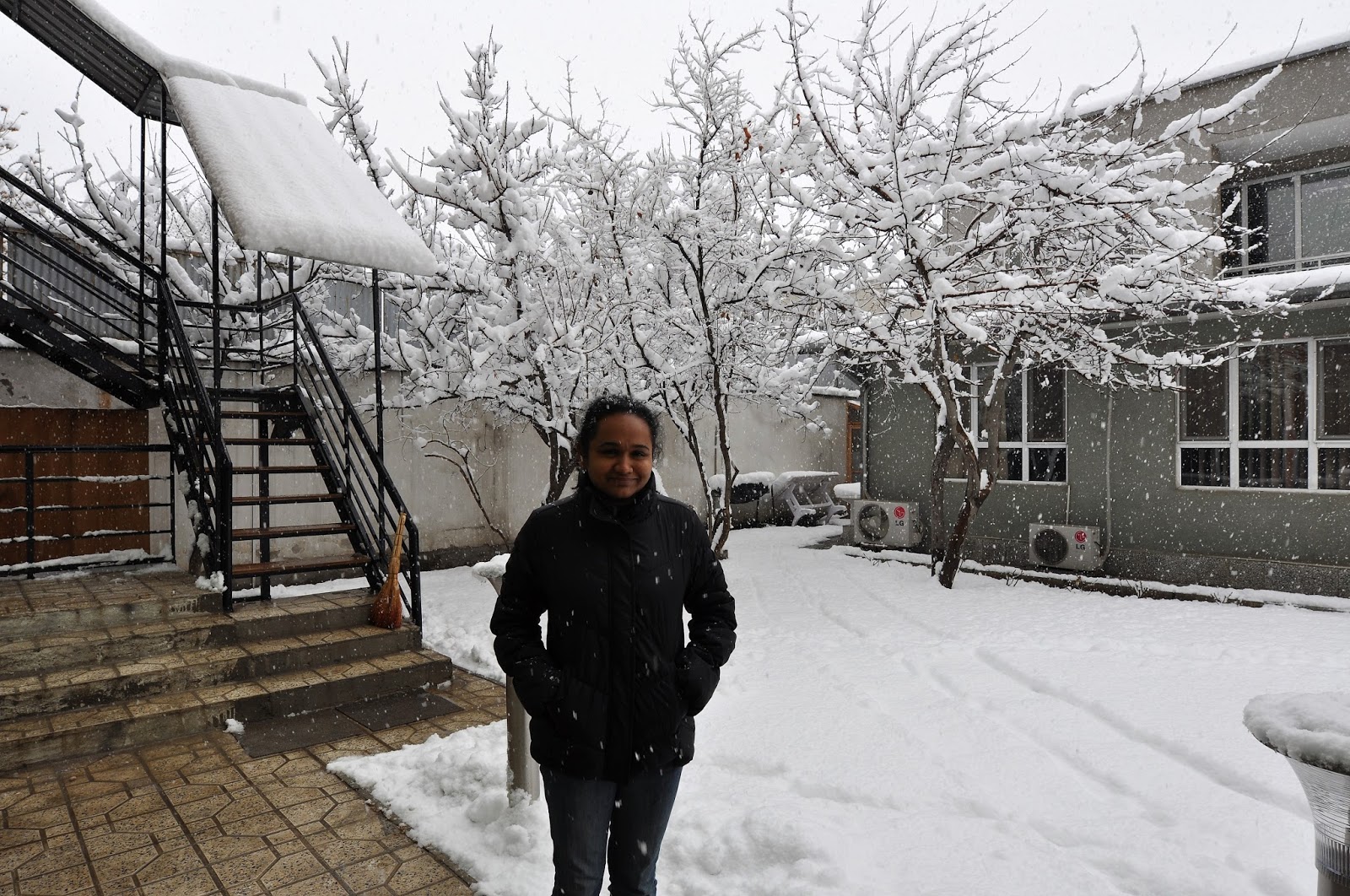
never having the heart to pluck any. Fairy tale winter experiences – witnessing
the first spell of snow, sauntering around office in heavy snow taking pictures
and breaking off icicles for no reason. Shopping at the Galleria, Istalif and
Zardozi. My hopeless search for a Kabul city map. Being audience to several
mesmerizing performances in office by the students of Afghanistan National
Institute of Music – I felt like royalty. Extended brunches and lounging at the
Serena with my besties. Office happy hours. Ladies’ lunches. Movie nights. Farewell
parties. Yes, when you spend so many years in a place, you bid many goodbyes
grudgingly. The list is infinite. I captured my experiences in a few random
articles, and the 1,000s of photos I shot and still treasure.

I lived in a sprawling 4-level house with eight others, communal
living if I may. We had a cook Zulmai (Zi for short), a maid and a gardener (our
gentle Baba, the cook’s father), who together took care of us very well. The sizable
lawn grew beautiful flowers, especially roses, and saw many badminton games.
During the days of power shortage, I remember huddling around the bukhari (traditional wood or saw dust
burning heater) with my housemates many winter evenings having animated
conversations, accompanied by generous servings of hot pakoras and masala chai.
Not to mention my struggle to converse in Dari – Baba, bukhari roshan! Baba, masheen
chalaan! – meaning to light up the heater or start the generator. These
were my famous winter lines. The mini projector was introduced in the home and
we ran our very own N Talkies! Outside home, the social scene was a culture
shock initially. In Chennai, my friends were from my school and college, and there
was a sense of familiarity. In Kabul, I constantly met with strange faces from
around the world. I found the

ultra-social personalities overbearing, although
they were helping me adapt. Also, because I lived in Afghanistan, I did not think my conversations had to always revolve
around aid and development. I came to dislike networking in all forms. So, I
stayed a recluse the initial months. But over time, I shed my inhibitions and learned
to be comfortable amongst unfamiliar crowds. Even better, I created my own little
world with a close group of friends I made for life. We shared similar
interests and together, we spent the weekends cooking, watching movies, making
holiday plans and sharing photography tips, heading reluctantly back to our
dwellings only at the stroke of 12 midnight – it was curfew time! We planned
and organized grand Diwali parties, Iftar
dinners and musical events at my place. We celebrated everything in equal
fervor. We truly celebrated diversity, and life. Those were good days.
 By then, my cook had
become an expert at making South Indian dishes. While the lunches and dinners
continued, I stopped hosting revelries to avoid unwanted attention. I don’t
remember when we transitioned to a full fleet of bullet proof vehicles or when
cars began to wait on me while I did my meetings at the client offices. The
local shopping became restricted, and I was thankful to be able to go to Finest
and Spinneys for my groceries even if only for 15 minutes, for these had good
print DVDs of English and Hindi movies! The restaurant list got shorter. I
missed going to Rumi and Sufi for their ambience, but my favorite brunch place,
Wakhan Café, remained on the list.

 My family was privy to everything I did in Afghanistan. I excitedly shared with them the little details about my life, work and travels. I was sometimes afraid of boring them with the stories, except that they saw it as being part of my journey. I missed the opportunity to bring them to Kabul while I lived in a private house. But during the breaks, I traveled with them like there was no tomorrow. While in Afghanistan, I sadly lost my dad, but happily welcomed my niece into this world. The media continued to project an inflated picture of the situation in Afghanistan, and with every bombing the pressure from extended family and friends was mounting. I learnt the art of damage control. But my immediate family remained staunch in its support of my decision to be in Kabul. Without their backing, I would not have lasted so long - I was the second longest serving staff on assignment in Kabul.


 advised
me not to stay long. I thought it must be a joke. But when I moved out of Kabul
in March 2014, it hit me. Most expat Kabulians live in a bubble. I had
forgotten for some time how it was to live a normal life. I only experienced
normalcy when I visited my family. Outside Afghanistan, I missed the high wire
environment, and anything less intense felt mundane. I simply missed being in
Kabul jaan! Over the years, I came to fall in love with this country and its
people; it was my home away from home. The experience will always remain
special and some day in the future, I hope to go back as a tourist to a
peaceful Afghanistan.

 school
students standing in line under the blazing sun, holding the Afghan flag and
singing the national song. But the one sight that remains etched in my memory
is of a young boy of about six years with pink sun-burnt cheeks and a UNICEF
bag hanging around his neck. All these children walked quite a distance to the
nearest school. Most often I may have taken it for granted, but these were
moments that made me realize how privileged I was to be part of my organization
– an organization that is partnering with countries like Afghanistan for a
better tomorrow. For good reason, I am reminded of the book I was given when I
joined in 2001. It is titled ‘Our Dream – A World Free of Poverty’.
It did not make much sense then. But now it does.


